Whereas buyers once searched Google, they now ask ChatGPT for advice. This changes which car dealers make it onto the shortlist before a customer even gets in touch.
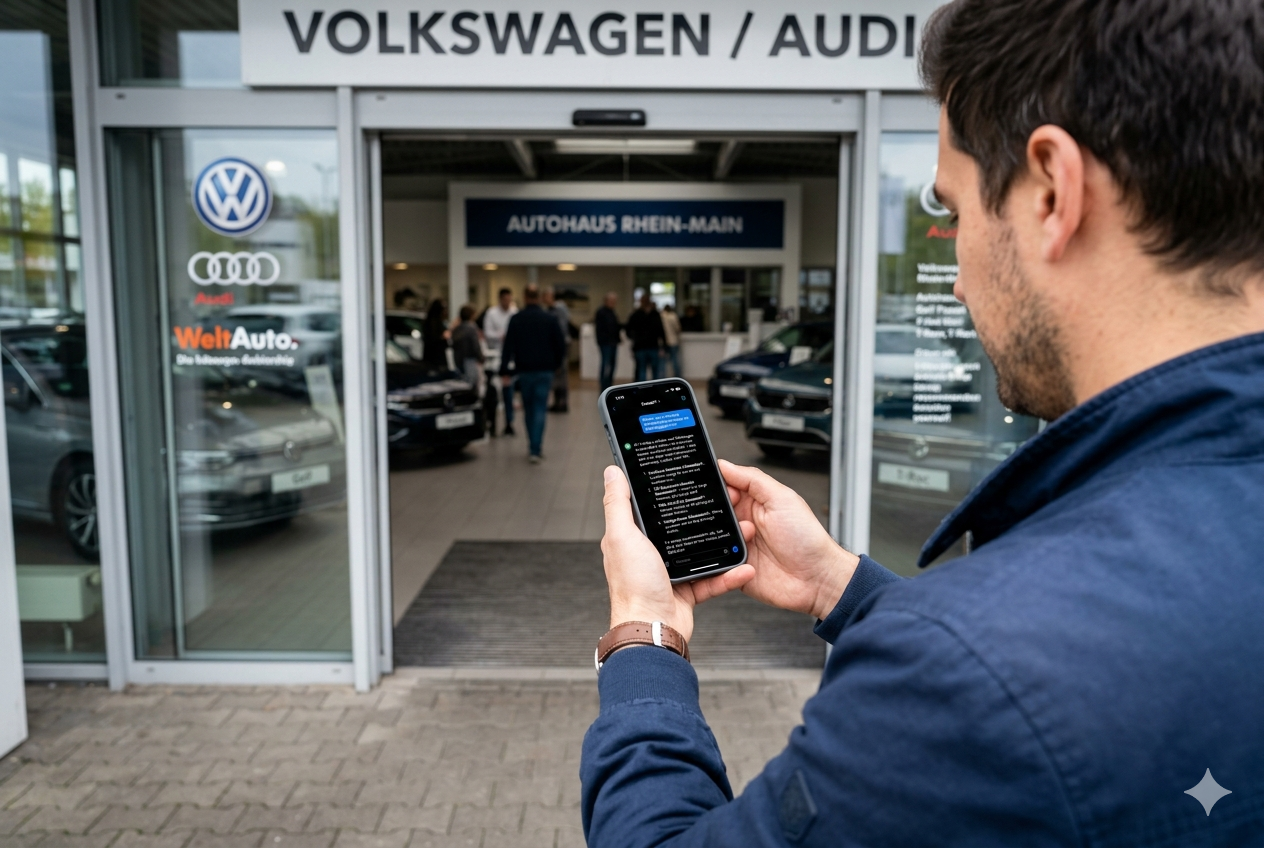
Give it a go. Open ChatGPT, Perplexity or Google’s AI Mode and type: which car dealer in my area is reliable for a used Volkswagen Golf around €15,000? Enter the name of the town where your business is located.
Is your business listed? Are you mentioned in the answer? Or do you see three or four competitors listed, but not yourself?
For most car dealerships, this is a new question. Two years ago, it did not exist. Today, it plays a decisive role in determining who even makes it onto a buyer’s shortlist.
From search query to request for advice
Ten years ago, a car buyer would start with a specific search query: buy Volkswagen Golf 2018. Google would return a list of adverts and dealer websites. The buyer would click, compare, call and visit.
Today, the same buyer is more likely to start with an open request for advice: what is the most reliable family car under €20,000 with less than 80,000 kilometres? The answer no longer comes from a list. It comes from an AI system that instantly generates a summary, a comparison or a shortlist.
That difference is not merely cosmetic. The buyer’s intention has shifted from I’m looking for offers to I’m asking for advice. And it is precisely that shift that changes which parties still play a role in the first phase of the buyer’s journey.
Google remains, but its role is changing
Google is still the starting point. In the 2024 Belgian Google/Kantar study, 79% of new car buyers used Search as an online source, and 66% used video. For used cars, those figures are likely to be similar or higher. The need for information is greater when it comes to used cars.
But Google’s own role is shifting. Since 2024, Google AI Overviews have been displaying an AI-generated answer at the top of many search results. The user no longer needs to click. The comparison happens before the click. Cox Automotive reports in the 2025 Car Buyer Journey Study that 19% of all car buyers and 25% of new car buyers used either AI websites, such as ChatGPT, Copilot and Gemini, or AI Overviews during their research. A year earlier, that share was virtually zero.
This is not a gradual shift. It is an adoption curve progressing faster than those of mobile internet or e-commerce.
AI as a new adviser
The use cases are concrete and recognisable. Buyers primarily use AI for three tasks:
-
Vehicle comparison. 44% of AI users in the CarGurus Consumer Insights Report 2025 used AI to compare vehicles side by side — not just on specifications, but on maintenance costs, reliability and total cost of ownership.
-
Summarising reviews. 39% used AI to distil thousands of reviews into a manageable assessment. Whereas it used to take an hour of watching YouTube reviews to form an opinion on a model, it now takes just five minutes.
-
Creating a shortlist. 40% used AI to filter listings based on a nuanced profile — the sort of question you might once have asked a tech-savvy uncle.
The Cars.com survey from November 2025 found that 44% of US consumers were already using AI-powered search tools on marketplaces, and 97% said AI would influence their purchasing decisions. For Europe, the figures are still patchy, but McKinsey found in early 2026 that 38% of consumers in France, Germany and the UK use AI when making shopping decisions. Of those, 63% did so specifically for comparison purposes.
The key trend: AI reduces weeks of research to a matter of hours.
From SEO to AEO and GEO
For car dealerships, this has practical implications that will almost certainly become decisive over the next twelve months.
The old playing field was called SEO: ranking on keywords, gathering links, appearing at the top of Google’s list. The new playing field is called Answer Engine Optimisation (AEO) or Generative Engine Optimisation (GEO): being mentioned in AI answers.
This fundamentally changes the requirements for your online presence. Instead of keyword density, what counts now is:
- Structured data. Schema.org markup for vehicles, current prices, specifications and warranties. Machine-readable, not merely visible.
- Factual reliability. AI systems cite sources they recognise as authoritative. A website full of marketing superlatives is cited less frequently than a site with clear, verifiable facts.
- Comparability. AI is constantly comparing. Anyone who does not explicitly position their own proposition against alternatives will simply be overlooked by an AI system that does.
- Third-party reputation signals. BOVAG quality marks, independent reviews and certifications are signals that AI systems recognise as indicators of trust.
Cars.com reported in September 2025 that it was the most cited automotive marketplace in ChatGPT, Google AI Overviews and Google AI Mode — twice as often as the number two. That is no coincidence. It is the result of data that has been structured and set up to be citable.
Winners and losers
The pattern is already visible:
Staying visible:
- Companies with rich, up-to-date stock data and clear filters
- Parties with independently verified reputation signals such as the BOVAG quality mark, BOVAG Import Tellercheck, NAP registration and customer reviews on independent platforms
- Websites that structure their information rather than obscuring it
Risk of disappearing:
- Listings without context or verification. A price and a photo are no longer enough
- Purely ad-driven pages with no factual added value
- Content that aims to persuade visitors but gives AI nothing to quote
What is striking is what does not disappear. The physical visit remains. In the BOVAG Customer Journey 2025, 53% of Dutch used car buyers visited just one car dealership. But the visit does happen. The 2024 IfA/AutoScout24 study found that only 20% of German used car buyers could imagine a fully online purchase. The dealer is not disappearing. Their role is shifting from source of information to point of validation.
And friends and family? They remain, as they have for decades, the most trusted source for a high-involvement purchase. AI does not make the kitchen-table conversation redundant. It changes its content. No longer which brand should I buy?, but my AI suggested these three; what do you think?
What you can test in practice
The simplest self-test takes five minutes:
- Open an LLM such as ChatGPT, Claude, Gemini, Mistral or Google AI Mode
- Type three questions your ideal customer might ask: for example, a reliable car dealer for used cars in [your town], where can I safely buy a used hybrid in [your region], which BOVAG-certified dealer in [your town] has good reviews
- See which companies are mentioned
- If your company is not listed, that is your work for the coming months
Conclusion
The battle for visibility in the first phase of the buyer’s journey is shifting from Google rankings to AI answers. For car dealerships, this means that the technical SEO reflex of the past fifteen years no longer works on its own.
That does not mean Google is disappearing or that AI is taking over everything. Google remains, but as a layer over which AI provides the summary. Marketplaces remain, but only if their data is machine-readable and verifiable. Your business remains, but as the final choice on a shortlist formed elsewhere.
Those not mentioned in AI answers are not invisible in an absolute sense. But they are passed over in the phase where the shortlist is formed. And a buyer who walks through the door with three competitors in mind is already two-thirds of the way gone.
That is the quiet revolution. Not a disruption with dramatic consequences, but a gradual reordering of who even comes into the picture.
This article is based on the Cox Automotive Car Buyer Journey Study 2025, the CarGurus Consumer Insights Report 2025, the Cars.com AI in Car Shopping Consumer Survey (November 2025), the IfA/AutoScout24 study Gebrauchtwagenkauf 2024, the BOVAG Car Customer Journey 2025, Google/Kantar consumer journey research Belgium (2024) and McKinsey agentic commerce analysis (2026).