European tolls are no longer a constant. According to the industry association IRU, toll costs for a reference truck in mid-September 2026 were around 17% above early 2023, and rates change somewhere in Europe almost every month. In 2026, new rates or systems arrived in the Netherlands, Flanders, Bulgaria and Romania, among others. A new wave follows on 1 January 2027. This overview covers what has already changed, what is coming and what you can sort out now as a transport partner.
Four systems side by side
There is no European toll. Countries choose their own system, and according to the IRU four exist side by side: no toll, a distance-based charge, a vignette for a fixed period, and toll gates with rates per location. In many countries the direction is the same, though: more distance-based charging and more weight for CO₂.
You can see this in how a rate is built up. A per-kilometre rate consists of a contribution to infrastructure, a charge for air pollution, sometimes a noise component and a CO₂ component. Since 25 March 2026, an air pollution charge must be applied on tolled roads, although there are exceptions. The CO₂ part depends on the CO₂ class of your truck, from class 1 (the most expensive) to class 5 (zero emission).
In Germany, the Lkw-Maut for a Euro VI combination above 32 tonnes in CO₂ class 1 is €0.348 per kilometre. About 45% of that is CO₂ and about 45% is infrastructure. Per kilometre, CO₂ therefore weighs about as much as the road itself. Since 1 July, a similar CO₂ differentiation also applies in the Netherlands and Flanders.
Note that all amounts in this article apply to that one reference: Euro VI, above 32 tonnes, five axles, CO₂ class 1. If you drive a different vehicle, the rate will differ. In the rate tables we consulted, we found no separate toll class for a car transporter. The standard combination category applies, unless weight, axles or registration lead to a different class.
What already changed in 2026
| Country | What changed | Rate (reference) | Status |
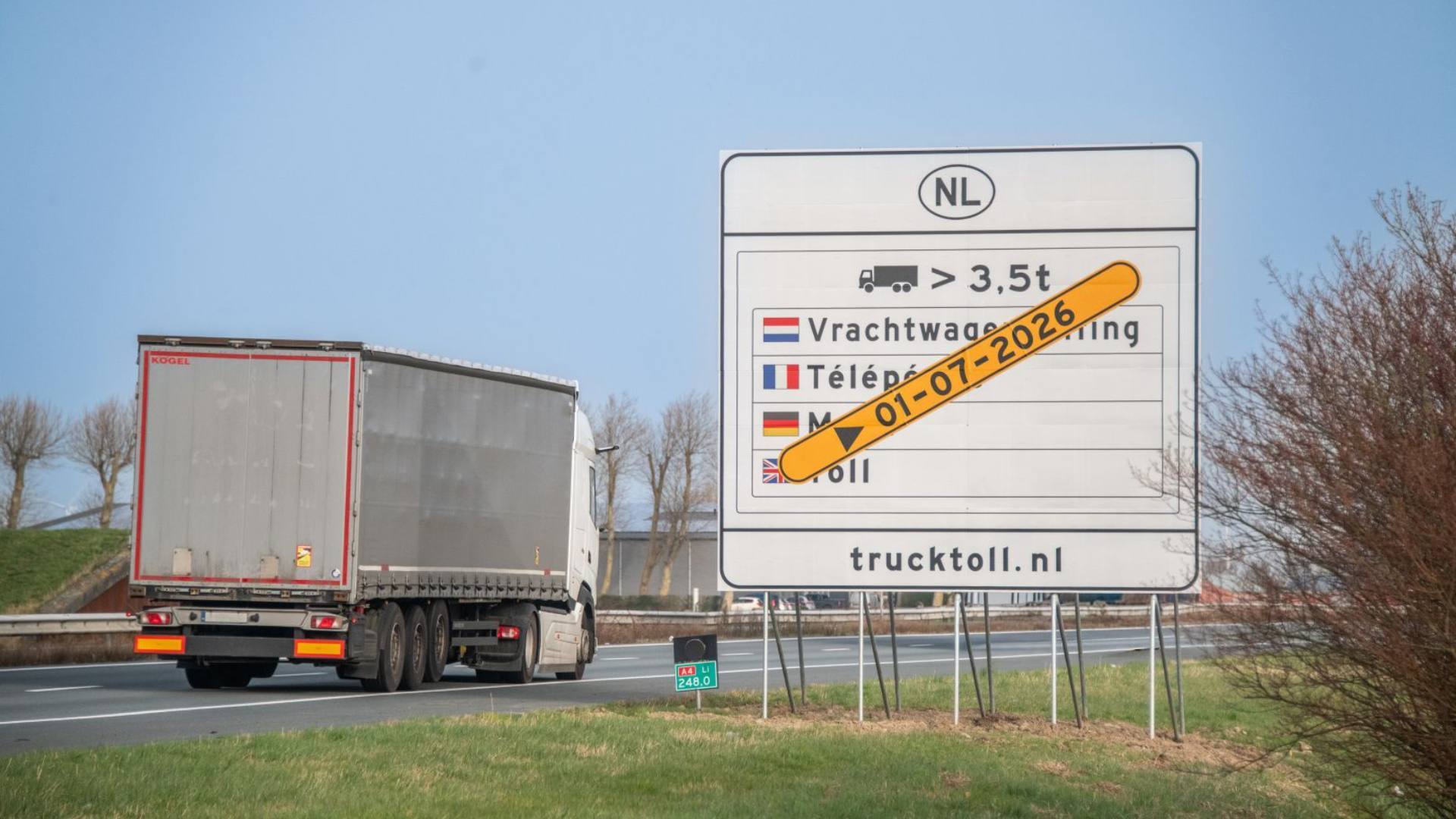
| Netherlands | Truck charge since 1 July, Eurovignette abolished; temporary 22.3% discount from 1 September to 31 December | €0.201 per km at the start, €0.156 per km with the discount | In force |
| Belgium | CO₂ differentiation in the Flemish distance charge since 1 July | Flanders €0.285, Wallonia €0.205, Brussels motorway €0.171, Brussels urban €0.271 | In force |
| Bulgaria | CO₂ component since 1 June | Motorway from €0.18 to €0.21 per km (about +17%) | In force |
| Austria | Higher GO-Maut, mainly due to the CO₂ component | €0.5724 per km excl. VAT (+7.65% compared to 2025) | In force |
| Poland | e-TOLL raised in two steps, network extended by about 645 km | PLN 0.40 (2025), 0.42 (1 Jan), 0.56 per km (1 Feb), above 12 tonnes, on motorways and S-roads | In force |
| Romania | TollRo has replaced the rovinieta for goods vehicles above 3.5 tonnes since 1 October | RON 0.48 per km on motorways and expressways, RON 0.24 on other national roads (Euro VI, from 12 tonnes) | In force |
Two things stand out. Flanders is the outlier: at €0.285 per kilometre, the CO₂ component puts the rate well above its level before 1 July. And the Netherlands shows how quickly a rate can shift: two different amounts within half a year.
What changes from January to April 2027
| When | Country | What | Status |
| 1 January | Netherlands | Back to full rates plus 2.6% indexation: €0.206 per km | Provisional |
| 1 January | Lithuania | Via Toll distance charge with CO₂ component; on average €0.111 per km for a Euro VI tractor above 12 tonnes with up to three axles | Planned |
| 1 January | Slovakia | Tolling taken in-house; SkyToll users need a new unit | Planned, audit office critical |
| 1 January | France (Alsace) | R-PASS for goods transport above 3.5 tonnes: €0.146 per km for Euro VI above 32 tonnes | Decided |
| 15 January | Romania | Interoperability via EETS expected | Planned |
| 1 March | Croatia | Free-flow tolling without toll gates, 5.8 GHz device mandatory for heavy vehicles | Enacted |
| 26 March | Sweden | Road-use vignette for vehicles above 3.5 tonnes | Enacted |
| 1 April | France (rest of Grand Est) | Regional charge on national roads | Provisional |
| Unknown | Denmark, Poland | Extension to 3.5 tonnes (DK), CO₂ and air pollution charge (PL) | No law yet |
The Netherlands: the jump on 1 January
The temporary discount runs until 31 December. On 1 January you will therefore see a jump on your invoice: from €0.156 to €0.206 per kilometre, roughly +32%. That is about €500 extra per 10,000 tolled kilometres. If you compare it with the rate at the start on 1 July (€0.201), the increase is only 2.6%. Both figures are correct; they simply have a different starting point.
Keep in mind that the 2027 rate is still provisional. As of 7 October we have not found a final decision in the Staatscourant (the Dutch Government Gazette). So check the rate again shortly before you plan or quote.
Slovakia and France: watch your unit
In Slovakia, the government is taking over tolling itself. If you use a SkyToll unit, you need to register again and get a new unit, from Czechtoll or an EETS provider. Re-registration is expected from 1 December. The Slovak audit office is critical of the project, so do not wait until January.
In France, mobile operators will switch off their 2G network by the end of 2026 at the latest. A unit that only works on 2G or 3G will then have to move to 4G or 5G. Whether that applies to your unit is best checked with your toll provider.
What you can sort out now
A yearly look in January is no longer enough. These are things you can pick up within a few weeks:
- Check the CO₂ class of every truck with your toll provider. It determines a large part of the rate.
- Look at your units. If you have a Slovak unit, a unit for Croatia (5.8 GHz) or a unit that only works on 2G, plan the swap before you drive there.
- Consider an EETS provider if you regularly cross several countries. One unit can then replace separate units and e-tickets, provided your provider covers the areas where you drive.
- Update your rate sheets per route. Start with the countries where you drive most often and check whether anything changed there this year, as in the table above.
- Note dates and status. A rate that is still provisional should not be passed on as certain.
What this means for your trip price
Tolls are one component of your costs, and how large it is depends on route, weight, Euro class and how full you drive. If you want to quickly see what a route costs, take a look at our overview of what 500 km of tolls cost in Germany and Austria and our explanation of the Dutch truck charge. If you also drive domestically in a country other than the one where you are established, the rules on cabotage apply as well.
Tolls are not the only thing that shapes your planning. Truck driving bans in Europe and the new tachograph rules matter too. You can read how prices are built up in 2026 in what car transport will really cost in 2026, and how a trip works with us under how it works.
If you see something in practice that differs from what is written here, for example a rate or a unit that does not work, please let us know. We will look into it. If you are not yet a transport partner, you can find more information on our page for car transporters.
Frequently asked questions
Why are tolls rising in Europe?
Countries are moving to distance-based charging and increasingly include CO₂ and air pollution in the price. Since 25 March 2026, the European framework requires an air pollution charge, with exceptions. That is one reason rates are rising in many countries, although differences remain and sometimes rates fall.
What changes in the Netherlands on 1 January 2027?
The temporary discount of 22.3% ends on 31 December. For the reference vehicle, that means a rate of €0.206 per kilometre (provisional), after an indexation of 2.6%.
What is a CO₂ class?
A classification of trucks from 1 to 5 based on their CO₂ emissions. Class 1 pays the highest rate, class 5 (zero emission) the lowest. Your toll provider can tell you which class your truck falls into.
Do I need an EETS unit?
You do not have to, but it can be useful if you cross several countries. Whether an EETS provider covers the areas where you drive is something you check with the provider.
Source: Directive (EU) 2022/362 and Directive (EU) 2025/2459 (EUR-Lex). Rates and decisions: Vrachtwagenheffing.nl and Staatscourant 2026, no. 18058 (Netherlands); Bundesfernstraßenmautgesetz, Anlage 1 (Germany); ASFINAG and Mauttarifverordnung (Austria); Viapass (Belgium); Постановление №64/2026 (Bulgaria); e-TOLL, gov.pl (Poland); Ordinul nr. 1925/2025 and Legea nr. 226/2023 (Romania); Collectivité européenne d'Alsace, R-PASS; Région Grand Est; Narodne novine NN 156/2025 (Croatia); Lag (1997:1137) om vägavgift (Sweden); NDS (Slovakia); Arcep (France). Toll index and the article that prompted this overview: IRU, "EU truck tolls: what changed in 2026 and what's coming in 2027", 6 October 2026. All rates as of 7 October 2026; rates can change almost monthly.