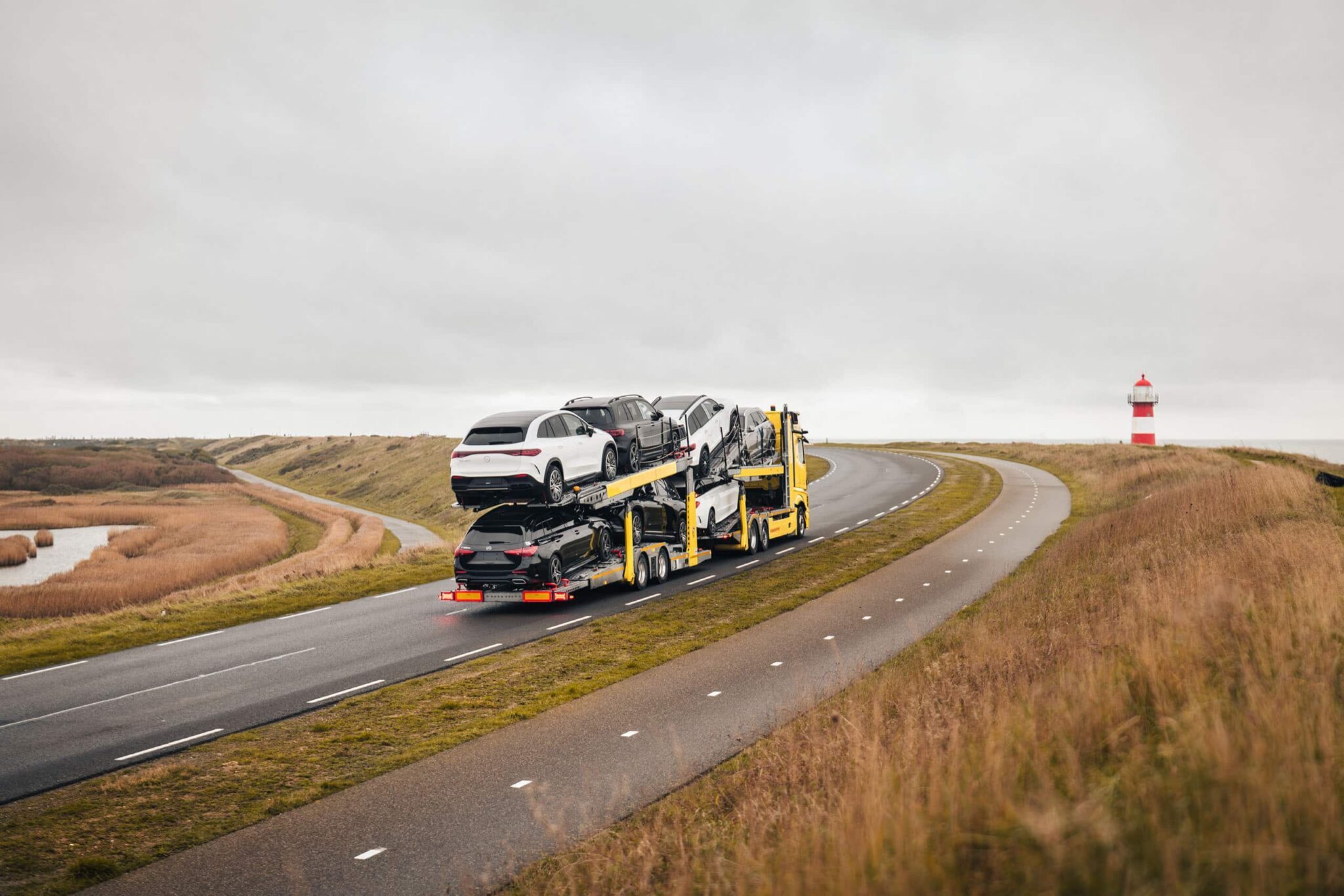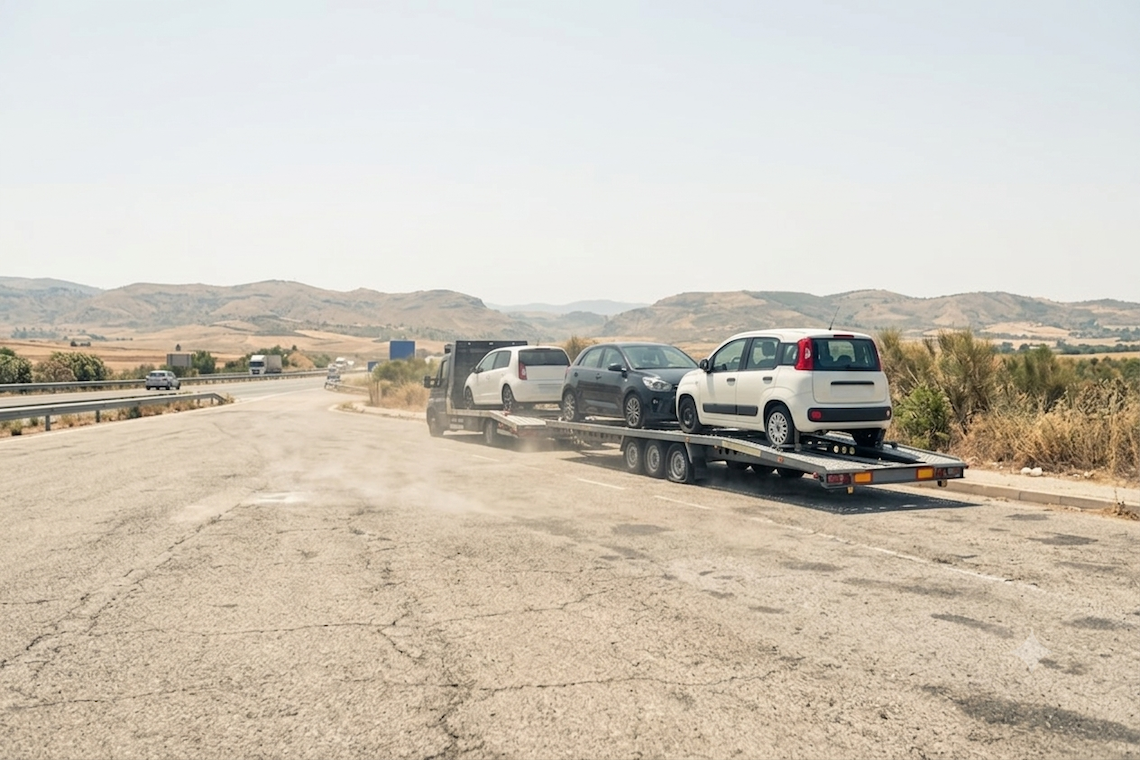
Late June. The thermometer already reads 38 degrees. Europe is in the grip of a heatwave. Somewhere on a service area along the motorway towards Germany, a three-car transporter sits with the engine running, load secured, driver waiting before pushing on. The air conditioning has stopped working. Not because he forgot to switch it on. The system gave up. Full load, full sun, full demand. At some point, the unit just quits.
That goes for new trucks as much as old ones.
This is not an exceptional situation. This is summer, for a large part of the car transporters driving through Europe.
That three-car transporter is one of the lighter vehicles in the network. Its weight puts it outside the extra summer driving bans that apply in Germany and France. Its battle is purely heat. The heavier combinations around it face both.
The air conditioning that gives out
People often assume drivers turn off the AC to save fuel. That's a misconception. The effect is negligible — and besides, who makes that choice deliberately at 38 degrees?
What is true is this: on a small truck of 150 to 180 hp, the AC compressor draws 3 to 5 kilowatts of power. That's 2 to 5 per cent of available engine output. On a straight road with half a load, that's nothing. But at full load, in traffic, on a gradient — that's precisely the margin that makes the difference.
The condenser plays a part too. It sits in front of the radiator in the cooling block. AC on means the condenser dumps warm air into the exact airflow that then has to cool the radiator. The AC cools the driver but simultaneously loads the engine's cooling system. In extreme heat, with a heavy load and low speed, these are communicating vessels.
At some point, the truck can't hold it. The ECU limits power. Or the driver makes the call himself: AC off, and hope the engine holds out until the next layby.
Andrei, one of our Romanian transport partners, knows the feeling well: "In summer the AC just can't keep up. The cab turns into an oven. At some point you switch it off — the engine needs that power more than you need the cooling."
The asphalt, the tyres, the brakes
Asphalt can reach 60 degrees Celsius in direct sunlight. Tyres soften. Tyre pressure rises by roughly 1.6 PSI for every 10 degrees of ambient temperature: a tyre that's properly inflated in the morning isn't automatically so in the afternoon. Under-inflation in the heat is one of the fastest routes to a blowout. That's bad enough in a car. In a loaded truck on the motorway, it's dangerous.
In the extreme summer of 2015, one of the hottest on record in Europe, tyre interventions by ADAC TruckService doubled on peak days to around 300 per day in Germany alone. That's 300 moments where a driver stands by the crash barrier, in the heat, next to a loaded vehicle.
Brakes show a higher risk of brake fade in sustained heat: they become less effective as they warm up, because heat reduces friction between pad and disc or drum. In traffic, on descents, on the hot stretches heading south. More alertness, bigger margins, more breaks.
Laurent, one of our French transport partners, puts it plainly: "The biggest problem in extreme heat is blowouts. In winter we have far, far fewer. And on storage yards it's worst — everything is tarmac, no shade, full sun. The work slows down. Everyone is exhausted."
On the service area
In the evening, he drives on. That's the solution some drivers apply in summer: night runs. The outside temperature drops, the engine has more margin, cooling works better. Technically, the best choice.
But that too has its limits.
European driving and rest time regulations are hard rules: a maximum of 9 hours driving per day, 11 hours of mandatory rest. A 45-minute break after 4.5 hours. Those rules apply in summer exactly as in winter. The night is also a narrow window, not free space.
And the service area is what it is. Not a hotel. No shower. Sometimes there are facilities, sometimes not. Bogdan, one of our Romanian transport partners, explains: "It's tough sometimes, in this heat. The cab heats up enormously and we don't always have access to a shower." Some trucks have no working air conditioning. Not because of a fault, but because the system was never fitted or stopped working long ago.
That is the reality of a broad network of over 2,000 transport partners across Europe. Not all large fleets with new trucks. Often one or two vehicles, a sole trader, the kilometres as bread and butter.
Shorter runs, less movement
Night driving solves heat problems in part, but creates new ones. Short trips — collecting from a dealer or delivering to a compound 40 kilometres away — are logistically unworkable at night. The dealer is closed. The compound too. Those runs disappear, or get pushed back.
Drivers who normally cover short pre- and post-carriage rounds often leave those aside in summer. Less flexible, less available for the shortest assignments. The network feels it.
The driving bans in the background
For heavier car transport combinations — vehicles above 7.5 tonnes or trucks with a trailer — a legal framework cuts available hours further in summer.
Germany has an extra Saturday ban in July and August on its busiest motorways, from 07:00 to 20:00. On top of the permanent Sunday and public holiday ban. A truck parked up on Friday evening has little driving window that weekend: banned Saturday 07:00–20:00, Sunday 00:00–22:00.
France applies five national lockouts in July and August: fixed Saturdays on which the entire road network is closed to freight traffic. Poland imposes strict holiday weekend windows for vehicles above 12 tonnes: Friday 18:00–22:00, Saturday 08:00–14:00, Sunday 08:00–22:00.
Marek, one of our Polish transport partners, is direct about it: "In summer the weekend is no longer a driving window. It stops on Friday, Saturday too, Sunday too. You wait — and you drive at night. That's how it works in July and August."
The three-car transporter on that service area, being a light vehicle, often falls outside those bans. Its problem is purely heat. But the heavier combinations around it don't. And those heavy combinations are part of the same network, the same routes, the same summer peak.
What this means for you
Every car delivered to you has a story. A driver who made a call while the cooling system was close to its limit. A service area somewhere in Germany at 02:00 in the morning. A run done at night because the margin was too tight during the day.
You don't see it. But it's there.
We connect your order to the partners in our network who know this work and do it. Over 2,000 of them, across Europe. They decide themselves how they drive, which windows they choose, when they rest. We handle the matching, and the transparency when something comes up.
One thing you can do: build in space during summer. Not because delays are inevitable, but because planning early and allowing slightly wider delivery windows makes a difference for everyone in the chain. Buying before mid-June for the summer peak gives the most room. After week 27, it tightens on all sides.
Want to know more about how car transport works? See how it works. Or read how we match orders to the right partner.
Frequently asked questions
Do summer driving bans apply to car transporters too?
It depends on the vehicle type. The extra summer bans in Germany and France apply to vehicles above 7.5 tonnes GVW, or trucks with a trailer. Lighter car transporters — such as a three-car transporter registered as an N1 vehicle — are normally exempt. Their summer challenge isn't a driving ban, it's heat. For the heavier combinations in the network, the bans apply in full.
Why do drivers run without air conditioning?
Not to save fuel. On a small truck of 150–180 hp, the AC compressor draws 2 to 5 per cent of engine power. On top of the heat the condenser puts back into the cooling block, that can be too much at full load and low speed. Switching off the AC is an emergency measure, not a choice. If it happens regularly, it points to a thermal borderline issue: a maintenance or capacity problem, not a deliberate economy measure.
What can I do as a dealer?
Planning early helps most. Orders placed before mid-June have the most margin ahead of the summer peak. Flag which deliveries are time-sensitive. And build slightly wider delivery windows into your customer agreements — not as a buffer for mistakes, but as a realistic summer standard.