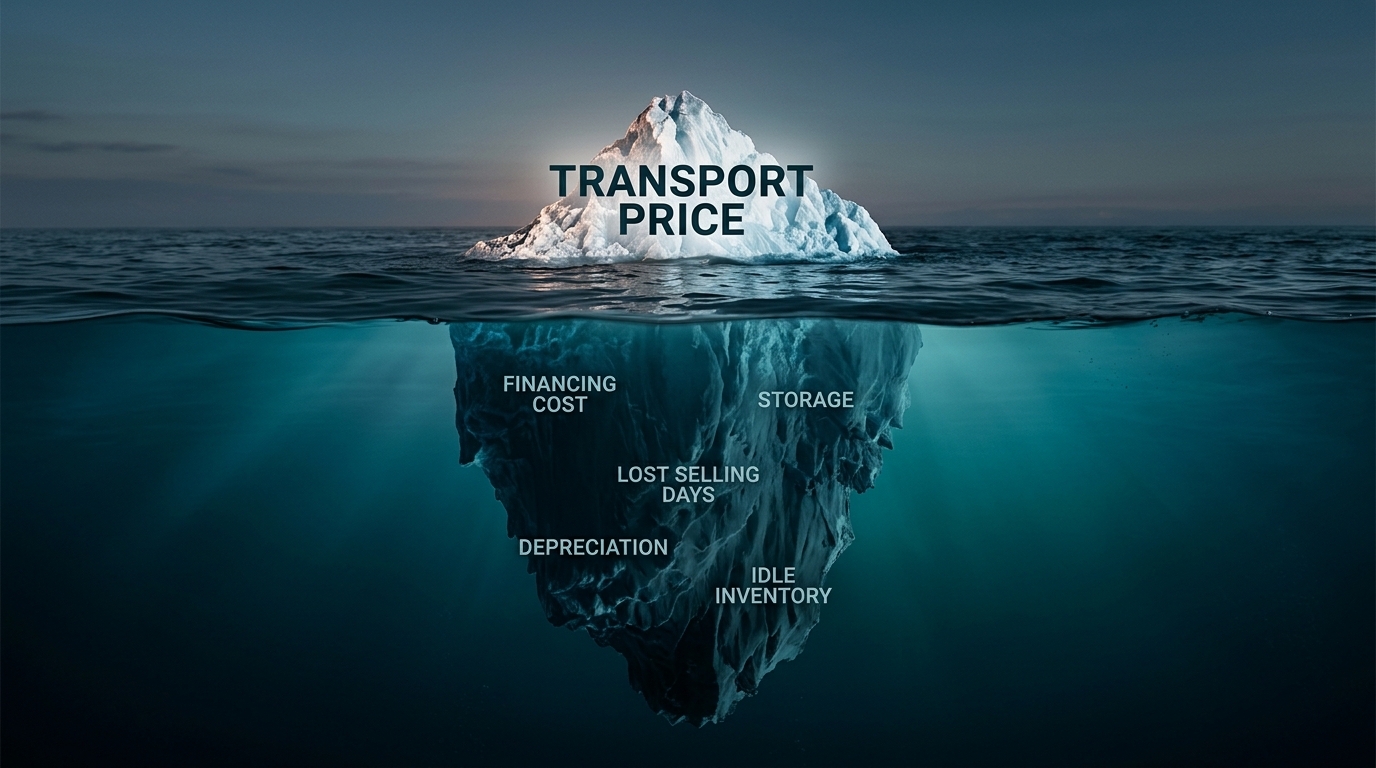
An ex-lease car is sold at auction. A car dealer wants the vehicle on the showroom floor as fast as possible; a fleet owner wants cash flow. Between those two moments lies more time than anyone expects, and that time is expensive. Not because of transport, but because of the days the vehicle sits on a compound beforehand. In the automotive remarketing process, this is the cost item that rarely shows up in a dashboard and is almost always underestimated.
What dwell time is, and why it is almost always underestimated
Dwell time is the time between the moment a vehicle is administratively sold and the moment it physically leaves the compound. It is therefore not the same as delivery time. Delivery time is what you communicate to the end buyer. Dwell time, sometimes called days on yard or days in stock, measures what happens before transport even begins.
In practice, dwell time creeps up without anyone actively steering it. It hides in the steps between auction sale, inspection, release and transport coordination. In dashboards it usually gets collapsed into other operational KPIs. Anyone who takes automotive remarketing seriously as a margin question must separate dwell time from days to turn and inventory aging. Three terms on the same time axis, but each measuring a different stretch. Only together do they form the complete picture of used car inventory turnover.
The compound: hidden hub in remarketing automobiles
The compound, also known as a vehicle processing centre, is where vehicles are prepared for their next owner between leasing companies, auction houses and end buyers. Unlike new cars, which run through fixed OEM flows, ex-lease vehicles, used cars and trade stock arrive through scattered channels. Operators like Mosolf, Koopman and Lagermax run the large European sites where intake, inspection, reconditioning and logistics planning come together. It is not a parking lot. It is a working floor where every day of idle time translates into value left on the table.
We described the operational anatomy of that floor in compound management as the strategic hub. This piece looks at the same compound through a different lens: what does it cost when that floor does not flow?
Why vehicles stand still when they should be "ready"
In practice, four causes explain most of the dwell time on a compound. None of them is a mistake. They are the links around transport, each costing a few hours or days, that add up to weeks.
- Yard management without real-time visibility. A vehicle stands three bays away from its planned position. The driver coming to collect it cannot find it without manual searching. That costs minutes per car and hours per load-out.
- Administrative release. Financing, customs and export regulation for cross-border transport (up to five working days), export documentation and licence-plate handover must all be settled before the vehicle can leave the gate.
- Inspection and reconditioning capacity. At lease quarter-end peaks, ex-lease vehicles queue for the wash bay, the damage inspection or the reconditioning bay.
- Transport coordination. One missing vehicle on the manifest blocks the entire load-out of a car carrier. Holding dedicated capacity rarely solves this. It only moves the problem to the next departure.
None of these causes sit in the trip itself. They sit before it.
What dwell time does financially in automotive remarketing
In a volatile used car market, a vehicle quickly loses 5 to 10% of its value in a matter of weeks. At the same time, interest, insurance, capital lock-up and floorplan costs keep running. For fleet owner remarketing and car transport for dealer groups, this is not an abstract line item. It is direct margin loss per vehicle, per day. And in a market where competition is sharp between car dealers, online platforms and traders, every euro of value lost to a slower process shows up immediately in the sale price.
A quick calculation makes it concrete. Take a vehicle of €18,000 sitting fourteen days longer than planned on the compound, in a softening market. Depreciation over that period moves towards €500 to €900 per vehicle, excluding holding costs and floorplan costs. One car is annoying. Scale it to a fleet owner or a business with 1,000 ex-lease vehicles per quarter, and dwell time becomes a seven-figure annual position. Residual value is not a fixed number; it is a function of time. We work that context out further in our analysis of the European used car market 2025.
Used cars treated as new
The same calculation applies to lease returns, fleet disposal and the daily stock rotation of an average dealer group. Used car inventory turnover is not a logistics KPI but a financial one. Every day less of dwell time is a day more of margin.
The paradox: more capacity, same lead time per vehicle type
At first sight, the answer looks obvious: add more trucks. Europe currently has roughly 30% less car-carrier capacity for finished vehicles than before the pandemic, with delivery times for new transporters running to fifteen months (ECG). Even so, extra capacity rarely fixes dwell time.
We worked that out earlier in the invisible bottleneck in automotive remarketing. Trucks often stand still not because there are too few of them, but because coordination between compound, carrier and buyer breaks down somewhere — and that breakdown is specific to the vehicle type. Ring-fencing dedicated capacity for one party raises that party's own predictability, but lowers the system efficiency of the chain as a whole. The lever is not capacity. It is coupling.
Where dwell time actually shrinks: four levers
On a number of European compounds, dwell time is now being structurally cut. Not by pushing harder, but by smoother handovers between links. The four mechanisms that work in practice are precisely the places where modern automotive remarketing differentiates itself from the version that was standard ten years ago.
- Digital gates with AI inspection. A 360° scan on arrival captures in ten to fifteen seconds what a manual inspection takes — depending on scope — anywhere from a few minutes to half an hour. The vehicle gets a status straight away (for example ready for transport, needs reconditioning or awaiting documents) that is readable for every chain partner. Vendors like ProovStation and UVeye publicly document scans of 3 to 15 seconds with inspection results on the dashboard within roughly two minutes. At Autoterminal Barcelona, a drive-through eGate of this type is coupled to about 1,800 vehicles per hour. At European compound operators themselves, the visible digitalisation today sits mainly in the status and document layer: Mosolf uses MYOUR (group-wide since July 2023) for real-time vehicle status and digital waybills; Koopman runs an intake and release app plus a customer dashboard. Publicly confirmed AI scan-gates on these operators' own sites do not exist yet. That is a market expectation, not a current standard.
- Real-time vehicle location on the compound. RTLS or UWB tracking shows where each vehicle physically sits. Search time disappears. A driver sees in advance which bays to hit. Vehicles are located quickly.
- Slot management at the gate. Carriers reserve a loading window. The compound makes sure the vehicles are in the dispatch zone on time. Empty kilometres and waiting time become the exception, not the rule. At Straßwalchen, Vienna and Sollenau, Lagermax uses the Cargoclix system for unloading slots, letting carriers schedule their own arrival. Autoterminal Barcelona combines the same principle with automated gate access and the AI scan mentioned above. For used-car and ex-lease flows, this kind of self-service slot booking at the gate is publicly far less common than it is for new vehicles.
- API integration between compound, transport platform and buyer. As soon as a vehicle is administratively released, that triggers an automatic transport plan. The dealer sees status updates in their own DMS. No emails, no manual updates, no waiting on a phone call.
Independent inspection bureaus such as SGS, Macadam and TÜV NORD play a verification role here. They underwrite inspection quality where AI scan and human judgement meet, so the digital status holds up legally as well.
What this delivers in practice
In the collaboration between CarOnSale and TransConnect, we see what this kind of coupling actually does: 99% delivery success, an average lead time of 4.4 days, and delivery times halved compared with the starting point. Not because of more trucks or a new contract form, but by linking release to transport planning. The full set of choices behind that sits in from auction to delivery and in the field lessons of Cars24's streamlined remarketing process.
Run the numbers on your own automotive remarketing volume. An order acceptance rate moving from 95% to 98% on 10,000 vehicles per year means around 300 fewer delayed vehicles. You see that directly in faster stock rotation. Cars sit shorter, and the pricing policy on older inventory no longer has to act as an emergency brake. There is simply less aged inventory.
What dealers and fleet owners can do tomorrow
Three steps help straight away, regardless of remarketing volume.
-
Measure dwell time per vehicle and per partner. Without data, every discussion about improvement is an opinion. Record, per vehicle and per vehicle type, when it was administratively sold, when it left the compound, and when it was delivered. Do that for at least thirty shipments before drawing conclusions. Patterns then appear: one specific compound, one specific weekday, one specific route.
-
Assess compound choice on digital maturity. AI inspection at intake, real-time location, slot management at the gate and open APIs are not a luxury. They are the minimum conditions for control over dealer inventory management and used car inventory turnover, and they decide which operational challenges you do or do not face. Compounds that have already implemented these steps efficiently deliver measurably shorter lead times.
-
Book transport on release, not on physical availability. Book the transport the moment the sale is administratively closed, not when the vehicle is physically ready. Let the platform handle coordination between compound and carrier. That usually saves a day or more at the start of the route.
To be honest, this is harder in practice than it sounds. The compound is the link in which dealers and fleet owners usually have the least visibility, and not every compound is eager to share its status. Some of the larger operators run their own logistics arm, which is in direct competition with independent platforms. Full transparency is then not automatically in their interest. That is not a reproach; it is a market reality that slows down the whole industry more than is strictly necessary.
What API integration with your DMS does solve in practice is the link between release and transport. Once the sale is administratively closed, the transport request can flow through automatically and the status comes back into your own system. Coupling the compound layer on top of that remains an ambition for the sector as a whole, not something any single party can enforce unilaterally.
Predictable lead time is a gain nobody notices
Dwell time is hidden, but not uncontrollable. The gain rarely sits in the fastest transport. It sits in the most predictable lead time. A chain where every link knows when its turn comes delivers shorter days to turn than a chain that buys in extra capacity at peak moments.
For anyone who wants to translate this into their own volume: work out a transport price, or look at what it costs to connect automotive remarketing to a platform that builds dwell time into its planning. That is usually the first step towards a lead time you can actually build on.