2027 is the year in which Brussels gives the car industry more breathing space and leaves more of the steering to the member states. European climate rules are partly postponed or relaxed, while tolls, levies and tax incentives become stricter country by country. More parties also gain access to vehicle data, and Chinese brands are starting to produce in Europe as well. And Europe would not be Europe if everything had already been agreed. In this overview you will find what is already certain, what comes into force later and what has yet to be decided.
Last year, in 2026: the year car transport undergoes structural change, we looked mainly at costs country by country. This time we sort by certainty.
What is certain in 2027
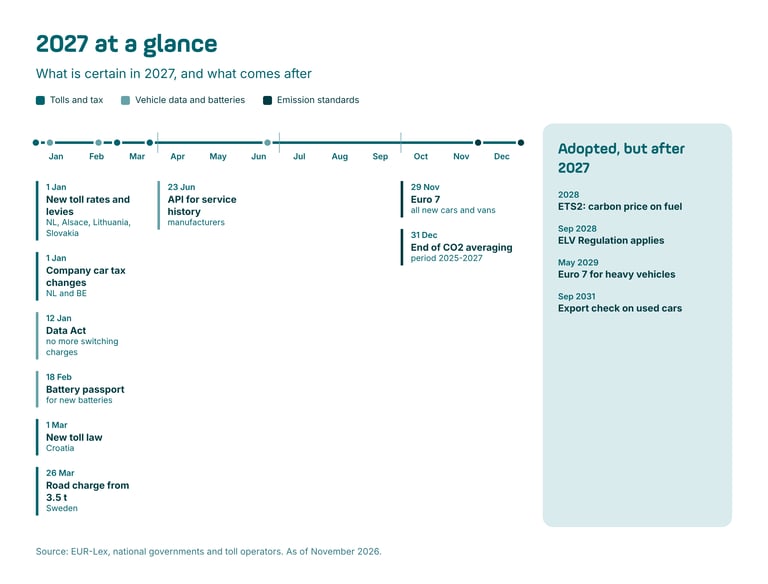
These changes are fixed, with a date, in legislation or official decisions.
| Date | Country | What changes | Who it affects |
| 1 January | Netherlands | Temporary discount on the HGV toll ends | Carriers, and through the transport price everyone who ships cars |
| 1 January | France | R-PASS levy for trucks in Alsace | Carriers |
| 1 January | Lithuania, Slovakia | Distance-based toll in Lithuania; Slovakia collects its toll itself | Carriers |
| 1 January | Belgium | Smaller toll discount for electric trucks in Flanders and Brussels | Carriers with electric trucks |
| 1 January | Netherlands | Employer levy on fossil company cars and higher benefit-in-kind for electric cars | Employers, leasing companies, fleet owners |
| 1 January | Belgium | Lower cost deduction for new electric company cars | Employers, leasing companies, fleet owners |
| 12 January | EU | Data Act: providers of data processing services may no longer charge switching fees | Companies switching cloud software |
| 18 February | EU | Digital battery passport for new electric car batteries | Manufacturers, importers, in time remarketing |
| 1 March | Croatia | New toll law and electronic collection | Carriers |
| 26 March | Sweden | Road charge extended to vehicles over 3.5 tonnes | Carriers |
| 23 June | EU | Manufacturers must make maintenance history and certain vehicle-specific information available via an API | OEMs, independent repairers, dealers |
| 29 November | EU | Euro 7 applies to all new cars and vans | OEMs, importers, new-car dealers |
| 31 December | EU | End of the 2025-2027 period over which carmakers may average their CO2 emissions | OEMs and importers |
Vehicle data and batteries
From 18 February, new electric car batteries get a digital battery passport, including information on the condition of the battery. It applies to batteries placed on the market from that date, not retroactively to electric cars already on the road. Who may see which data varies: information on the condition of the battery is not simply public.
From 23 June, OEMs must give independent repairers access via an API to the electronic maintenance history and to certain vehicle-specific information. This runs through a third party and requires the customer's consent. What this means for dealers is explained in our blog on API access to maintenance history. Earlier, on 12 January, the Data Act's ban on switching fees for data processing services takes effect. Whether your dealer management system is covered depends on the system and the contract. More on the Data Act in vehicle data under control.
Transport costs: tolls, fuel and wages
On 1 January, the temporary discount on the Dutch HGV toll ends. According to the official Dutch toll website, the rate for a Euro VI truck over 32 tonnes in CO2 class 1 then rises from €0.156 to €0.206 per kilometre. Compared with the temporarily reduced rate that is 32% more; compared with the original rate it is an indexation of 2.6%. Tolls also change on 1 January in Alsace, Lithuania and Slovakia, on 1 March in Croatia and on 26 March in Sweden. In Flanders and Brussels, according to Viapass, the toll discount for electric trucks falls from 80% to 60% of the infrastructure component. What carriers need to arrange is set out in European tolls 2027.
Costs are moving outside tolls too. In Germany, the temporary reduction of 14.04 cents per litre in diesel tax ends on 1 January. The statutory minimum wage rises by 5% to €14.60 an hour in Germany, by 3% in Poland and by 2% in the Netherlands. These figures do not add up to a single percentage increase in car transport costs: that depends on route, load factor and vehicle.
Tax incentives in four countries
The four countries we follow in this series each push towards electric in their own way:
- Netherlands: from 2027, employers pay a 12% levy on fossil and hybrid cars they newly make available to staff. The benefit-in-kind rate for new electric cars rises from 18% to 20% on the first €30,000.
- Belgium: for new electric company cars bought or leased in 2027, the cost deduction is 95% instead of 100%. For fossil company cars under the transitional scheme, the deduction falls further.
- Germany: the purchase subsidy for private buyers (€1,500 to €6,000) continues. The conditions for plug-in hybrids are fixed until 30 June.
- France: under current law, the CO2 malus applies from 103 grams per kilometre, compared with 108 grams in 2026. The French budget for 2027 may still change this.
There is no level European playing field. Anyone remarketing or moving cars across borders deals with four different sets of rules.
Euro 7 in November
Euro 7 is the new European emissions standard. Besides exhaust emissions, it sets requirements for brake particle emissions and for the durability of electric car batteries for the first time. From 29 November, Euro 7 applies to all new cars and vans. For new vehicle types it already applies a year earlier, on 29 November 2026. Type approval and first registration therefore become more important when planning new vehicles. On 31 December the three-year period over which carmakers may average their CO2 emissions also ends. The settlement follows afterwards.
Certain, but only after 2027
Several measures are often linked to 2027 but come into force later:
- ETS2, the European emissions trading system for road transport and buildings, starts in 2028 instead of 2027.
- The ELV Regulation on end-of-life vehicles has been adopted, but only applies from 1 September 2028. The new check on exports of used cars outside the EU starts on 1 September 2031.
- Euro 7 for heavy vehicles applies to new types from May 2028 and to all new trucks and buses from May 2029.
What is still open
Part of the news about 2027 concerns plans that have not yet been adopted:
- The proposal to lower the 2035 CO2 target for new cars from a 100% to a 90% reduction, and a proposal to green corporate fleets.
- A new truck levy in the rest of the Grand Est region, planned from early April.
- The extension of the Danish distance-based toll to vehicles over 3.5 tonnes, planned for early January but still subject to approval by the Danish parliament.
- The Dutch 2027 tax plan and the French budget for 2027, both still under discussion at the time of writing.
What this means for vehicle flows
More electric cars coming in
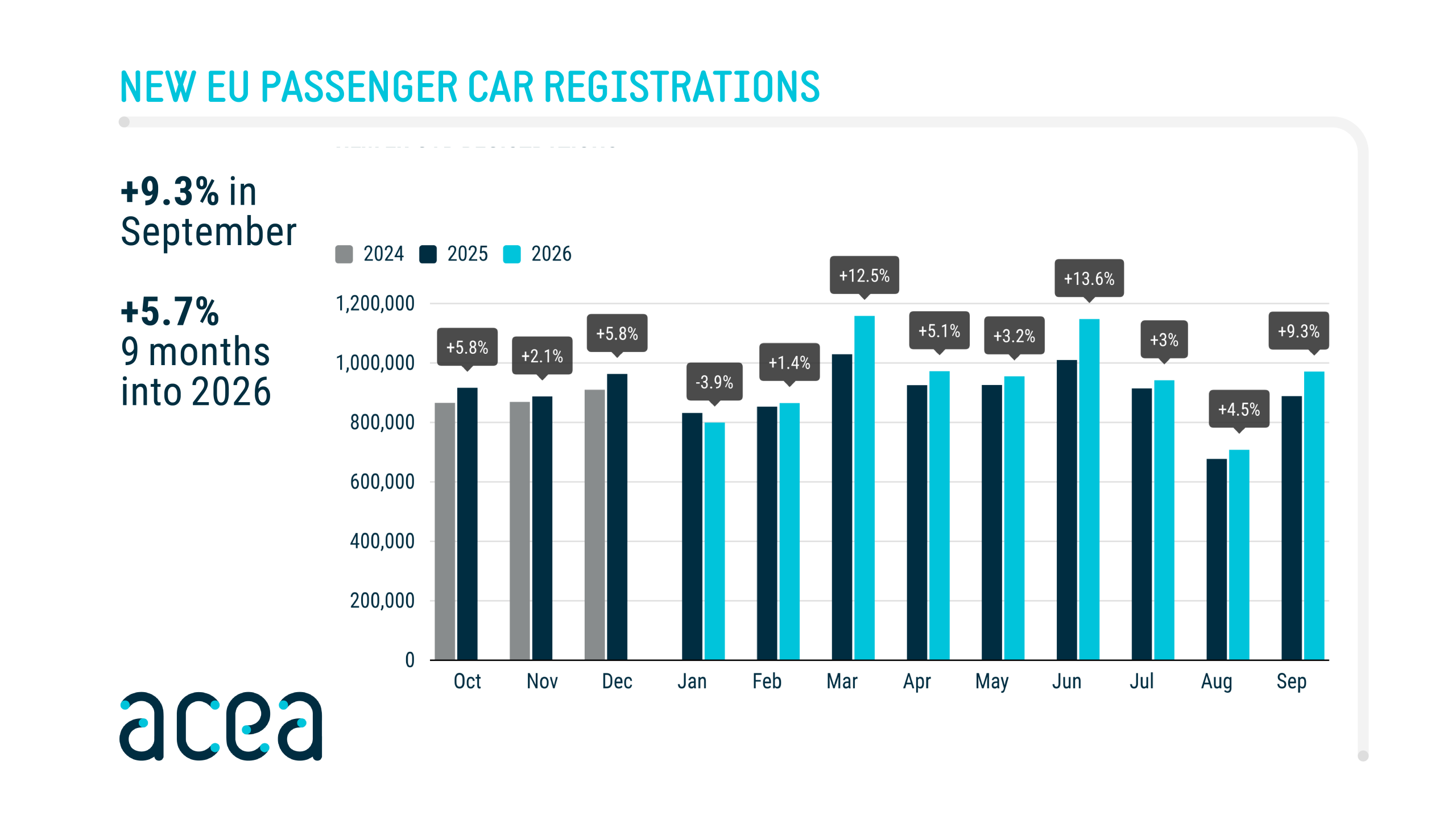
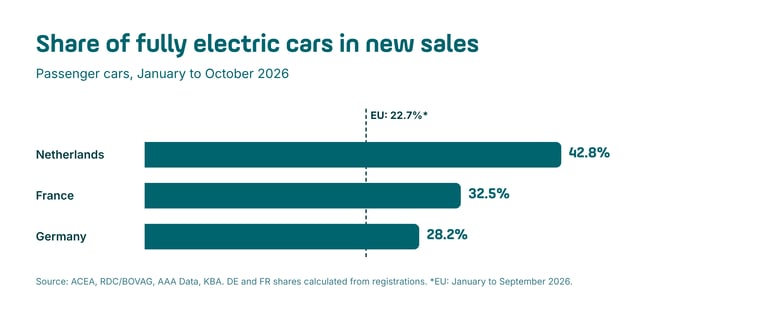
The share of fully electric cars in new car sales is growing fast. In the EU it was [ACEA-UPDATE] 22.7% from January to September 2026. In the first ten months it was 42.8% in the Netherlands, 32.5% in France and 28.2% in Germany. For the Netherlands, the Dutch trade associations BOVAG and RAI Vereniging expect 371,000 new cars in 2027, around 60% of them electric. We wrote earlier about the growth of the European car market in EU car market grows.
Chinese brands start building in Europe
Chinese brands are partly shifting from imports to production in Europe. Leapmotor has been building the B10 in Zaragoza since October 2026 and, according to Leapmotor, will add the B05 there in the first quarter of 2027. XPeng and GAC have cars produced by Magna in Graz. Ford and Geely plan to start a joint venture in Valencia in 2027 (subject to approval), but the first new models will not roll off the line there until 2028. The European duties on Chinese electric cars remain in place. For vehicle logistics, this adds new points of origin next to the import ports: factories in Spain and Austria. We wrote about this earlier in Chinese EV production in Europe.
Used electric cars look for their market
In October 2026 the Netherlands imported more used electric cars than it exported: 3,104 against 2,476. A year earlier it was the other way round. At the same time, lease cars from the strong electric model years 2023 and 2024 will be returning over the coming years. Exactly how many will come back in 2027 depends on contract terms and extensions and cannot yet be reliably forecast. What is clear is that the question of where a used electric car sells best is becoming more important.
What to watch now
- Dealers: keep an eye on the Euro 7 date and the status of stock vehicles, and check which vehicle data you will be able to request via the API.
- Leasing companies and fleet owners: factor the tax changes in the Netherlands and Belgium into the timing of replacements, and allow for more returns of electric lease cars.
- Importers and OEMs: watch Euro 7, the CO2 settlement for 2025-2027 and the changing origin of vehicles.
- Anyone shipping cars: ask your transport partner how toll changes are reflected in the price.
Frequently asked questions
Does Euro 7 come into force in 2027?
Yes. From 29 November 2027, Euro 7 applies to all new cars and vans. For heavy vehicles the standard follows in 2028 and 2029.
Does European emissions trading for fuel (ETS2) start in 2027?
No. ETS2 has been postponed to 2028.
Will every used electric car get a battery passport?
No. The battery passport applies to batteries placed on the market from 18 February 2027, not retroactively to cars already on the road.
Will car transport become more expensive in 2027?
Several cost items are rising, such as the Dutch toll, German diesel tax (the temporary reduction ends) and minimum wages. How much difference that makes per transport varies by route and load. There is no general percentage.
When does the new export check for used cars start?
On 1 September 2031. The ELV Regulation itself applies from 1 September 2028.
The Automotive 2027 series
Over the coming weeks we will look at the main themes in more detail:
- Chinese brands are building in Europe: what does that mean for vehicle logistics?
- What does car transport cost in 2027?
- Four countries, four tax incentives: how fleets change in 2027
- From exporter to importer: the Netherlands and the used electric car
- The battery passport and vehicle data: what changes for remarketing?
- Euro 7 and beyond: what comes after 2027?
Follow us on LinkedIn or sign up for our newsletter so you don't miss an instalment. Read more about how we organise car transport in Europe. If you have questions about 2027, feel free to get in touch.
Sources: Regulation (EU) 2024/1257 (Euro 7), Art. 21; Regulation (EU) 2025/1214 (CO2 averaging); Regulation (EU) 2026/667 (ETS2); Regulation (EU) 2023/1542 (batteries), Art. 77; Regulation (EU) 2023/2854 (Data Act), Art. 29; Delegated Regulation (EU) 2026/699 (repair and maintenance information); Regulation (EU) 2026/1738 (ELV); Staatscourant 2026, 18058 and vrachtwagenheffing.nl (Dutch HGV toll); Viapass, October 2026; Collectivité européenne d'Alsace (R-PASS); Narodne novine 156/2025 (Croatia); Lag (1997:1137) om vägavgift (Sweden); German Federal Ministry of Finance (energy tax); Rijksoverheid, Bundesregierung and Dz.U. 2026 poz. 1213 (minimum wages); Rijksoverheid (employer levy, benefit-in-kind); Belgian FPS Finance (cost deduction); BMUKN (German EV subsidy); Code des impositions sur les biens et services (malus); ACEA, 22 October 2026 [ACEA-UPDATE]; BOVAG/RDC, KBA/VDA, AAA Data (registrations October 2026; shares for DE and FR calculated from the figures); BOVAG and RAI Vereniging, forecast 22 October 2026; BOVAG/RDC, used car market October 2026; Stellantis, 16 and 19 October 2026; Ford and Geely, 23 July 2026; Implementing Regulation (EU) 2024/2754.