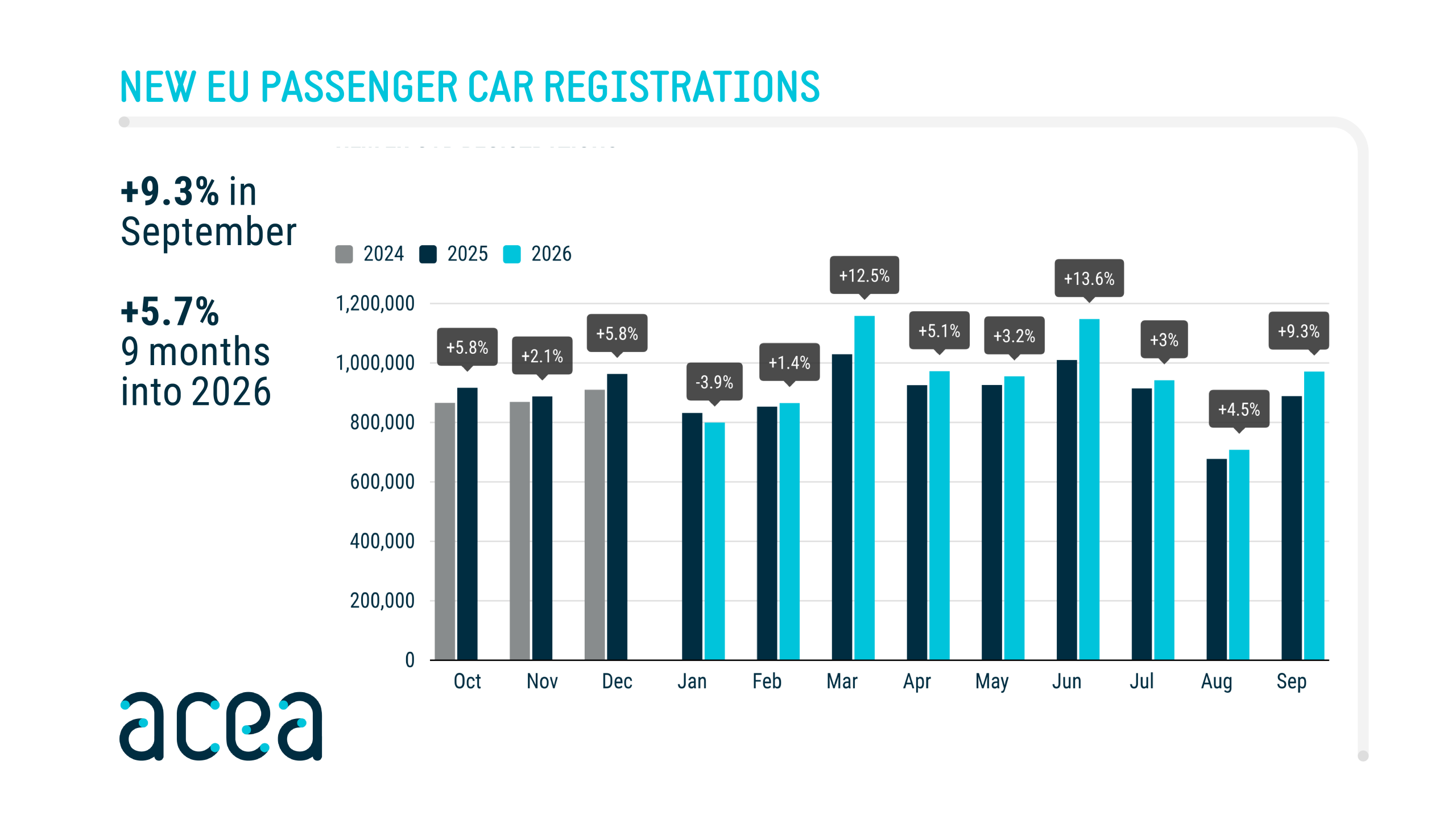
In September, 971,048 new passenger cars were registered in the EU. ACEA, the European Automobile Manufacturers' Association, reported this on 22 October. That is 9.3% more than in September 2025. Over January to September, growth is 5.7%.
For dealers and remarketers, that is good news. More new cars mean more choice for customers, more trade-ins and, in a few years, more used cars. If you plan now for purchasing, trade-ins and stock allocation, you will be better placed later. We previously wrote about the pressure on margins and aftersales. This article covers the opportunities.
Where the growth comes from
Electric is the biggest driver. In September, 29.9% of new cars in the EU were fully electric (BEV). BEV registrations rose 72.9% to 290,117. Over the first nine months, the BEV share was 22.7%, compared with 16.1% a year earlier. Petrol and diesel fell by 19.1% and 19.5% over that period.
ACEA calls the market resilient, despite high energy prices and geopolitical tensions. According to ACEA, the growth is supported by buyer support measures and a broader model offering.
New brands are also gaining share. In the EU, BYD went from 1.0% to 2.4% market share over January to September, Chery from 0.5% to 1.6% and Leapmotor from 0.2% to 0.9%. These growth rates are large because they start from a small base. Leapmotor grew 393.6% over that period and is still below 1%. The six largest traditional groups together still held 73.3% of the market, against 76.7% a year earlier (own sum of the ACEA shares).
The picture differs by country. Germany registered 5.3% more new cars over January to September and France 4.1% more. The Netherlands registered 1.9% fewer (264,701 cars), but 16.2% more BEVs (109,024). The EU is therefore not growing at the same pace everywhere.
| Figure | 2025 | 2026 | Change |
|---|---|---|---|
| New passenger cars | 888,529 | 971,048 | +9.3% |
| BEV registrations | 167,776 | 290,117 | +72.9% |
| BEV share | 18.9%* | 29.9%* | +11.0 percentage points* |
Perimeter: EU. Reference date: ACEA, 22 October 2026. The 2026 figures are provisional. *Own calculation from the ACEA volumes. ACEA does not publish the September share.
| Figure | 2025 | 2026 | Change |
|---|---|---|---|
| New passenger cars | 8,056,511 | 8,517,059 | +5.7% |
| BEV registrations | 1,300,288 | 1,931,465 | +48.5% |
| BEV share | 16.1% | 22.7% | +6.6 percentage points |
Perimeter: EU. Reference date: ACEA, 22 October 2026. The 2026 figures are provisional.
| Manufacturer or group | 2025 | 2026 | Change (percentage points) |
|---|---|---|---|
| Volkswagen Group | 27.5% | 26.2% | -1.3 |
| Stellantis | 15.8% | 15.8% | 0.0 |
| Renault Group | 11.4% | 10.4% | -1.0 |
| Hyundai Group | 7.6% | 7.0% | -0.6 |
| Toyota Group | 7.4% | 7.0% | -0.4 |
| BMW Group | 7.0% | 6.9% | -0.1 |
| BYD | 1.0% | 2.4% | +1.4 |
| Tesla | 1.4% | 2.2% | +0.8 |
| SAIC Motor | 1.9% | 2.2% | +0.3 |
| Chery | 0.5% | 1.6% | +1.1 |
| Leapmotor | 0.2% | 0.9% | +0.7 |
Perimeter: EU. The share is the portion of all new passenger cars, across all powertrains, so not only BEVs. The table shows the six largest traditional groups and five brands that are growing fast in the EU. It is a selection from the ACEA table, not the full overview. ACEA shows Leapmotor separately from Stellantis. Reference date: ACEA, 22 October 2026, provisional figures. The change is calculated from the rounded shares.
More new cars, more movement in the chain
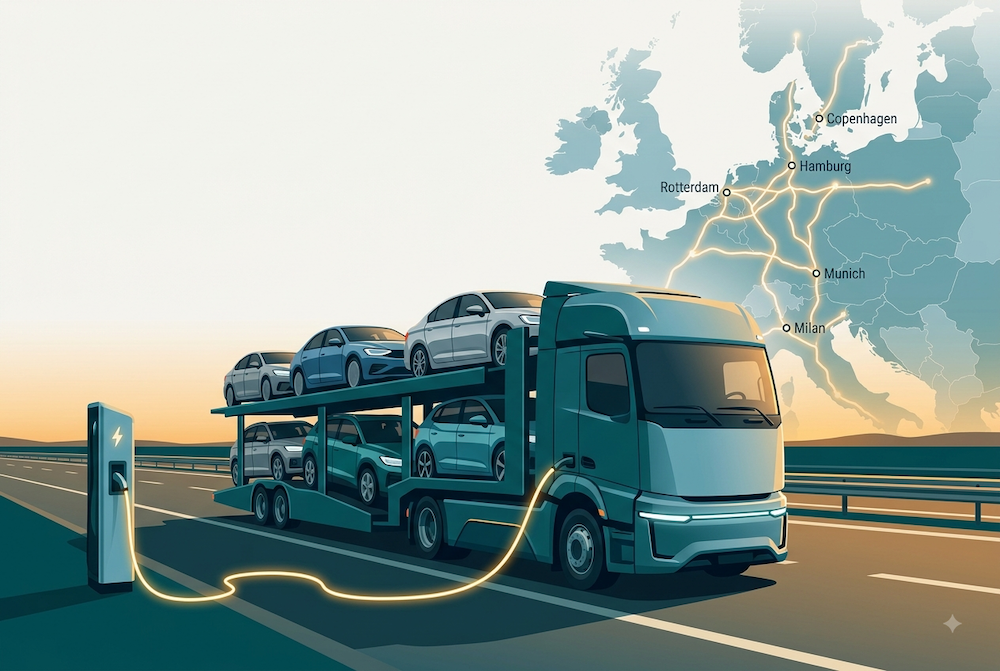
Almost every new car travels from factory or port to a dealer. More registrations mean more of these journeys and more trade-ins at dealers. Where cars come from is also changing. More brands mean more different routes. Some Chinese brands are also starting to produce in Europe. We wrote about this in Chinese EV production in Europe.
We see vehicles moving from auction and compound to dealer, across borders. A registered car is not yet a sold car. Logistics sits between the two. As the market grows, that part of the chain becomes more important. Read more about car transport across Europe.
What the growth means for used cars in three years
A new car returns as a used car after a few years. In France, in the second quarter of 2026, 58% of used BEVs sold by professionals were between 3 and 5 years old (Avere-France and Mobilians). Cars registered in 2026 are therefore expected to return to the used car market from 2029.
More than half of BEV registrations from January to September took place in two countries: Germany (604,144, +58.1%) and France (387,342, +79.1%). We found no European series that measures the delay by country. The return from 2029 is therefore an expectation, not a measurement.
The starting point is favourable. In July 2026, demand for BEVs aged two to four years exceeded supply in all European markets surveyed (JD Power). BEVs sold the fastest of all powertrains in Austria, France, Germany, Spain, Switzerland and the United Kingdom. Since January, prices of used BEVs have risen in Germany, France, Spain and Italy. That points to strong demand.
Not every car stays in the country where it was first sold. The Netherlands exported 37,167 used BEVs in 2025 and imported 12,165 (BOVAG/RDC). Net, more than 25,000 used BEVs therefore crossed the border. That picture is changing. According to Autotelex, exports of electric passenger cars from the Netherlands through May 2026 fell by more than 1,000 units compared with the same period in 2025 (then 16,031), while imports doubled (then 4,473).
Used EVs to Denmark
France shows the same pattern as the Netherlands, on a smaller scale. According to French customs, France exported 6,887 used electric vehicles in 2024, against 3,280 in 2023. Imports grew from 695 to 1,996. Net, that was 4,891 vehicles in 2024.
For Germany we found no national figure. Trading platform Auto1 does report that three quarters of the electric cars it trades are exported. That is one trader's figure and says nothing about the whole German market.
Demand is also found in other countries. Denmark imported 78,100 used BEVs in 2025, on average 2.4 years old (AutoUncle/Statistics Denmark). These figures come from different years and sources and cannot be compared with each other. They do show that a car sold new in one country can be traded again in another. For anyone who can match supply and demand across countries, that is an opportunity.
New brands have little residual value history yet
For new brands, there is still little residual value history. That is something you can manage. In Germany, the residual value of Chinese EVs and plug-in hybrids fell from 61% at the start of 2024 to 47% at the beginning of April 2026 (German and Dutch trade media, based on Automobilwoche and DAT, among others). For all EVs and plug-in hybrids together, the fall was 7 percentage points, for this group 14. Autotelex reported in June that residual values of EVs in the Netherlands will continue to rise in 2026. Chinese brands are rising too, but more slowly. The German figure does not automatically apply to other countries. Several factors play a role, such as brand awareness and the size of the dealer network.
Frequently asked questions
Is the European car market growing in 2026?
Yes. In the EU, 971,048 new passenger cars were registered in September, 9.3% more than a year earlier. Over January to September, growth is 5.7% (ACEA, 22 October 2026, provisional figures). Not every country keeps pace. The Netherlands registered 1.9% fewer new cars over January to September.
How many of the new cars are electric?
In the EU, by our calculation, 29.9% of new cars were fully electric in September. Over January to September it was 22.7% (ACEA, EU).
How long does a used car stay on sale?
That differs by powertrain and by country. JD Power reported that BEVs sold the fastest of all powertrains in six European countries in July 2026. The source does not give the number of days. For an EV, long idle time also costs battery capacity (Dekra: 3 to 4% at a high state of charge).
Do you spread your stock across several branches or countries? Then read how we work for dealer groups with multiple locations.
Source: ACEA, press release "New car registrations: +5.7% in September 2026 year-to-date; battery-electric 22.7% market share", 22 October 2026. EU perimeter unless stated otherwise. 2026 figures are provisional.
Source: JD Power Monthly Market Update and RV Index (July 2026), via Fleet Europe, 8 September 2026.
Source: Avere-France and Mobilians, Baromètre semestriel des voitures électriques d'occasion, July 2026 (AAA Data).
Source: BOVAG/RDC, 2025.
Source: Autotelex market update June 2026 (autotelex.nl).
Source: French customs, via Journal de l'Automobile, 25 June 2025.
Source: Auto1, via ecomento (referring to Automobilwoche), 9 September 2026.
Source: AutoUncle and Statistics Denmark (Denmark, 2025).
Source: Residual value figures for Chinese EVs and plug-in hybrids in Germany: Automobilwoche (via ecomento, 27 May 2026) and DAT (via AD.nl and Aftersales Magazine, 2 June 2026).
Source: Dekra (Michael Tziatzios), via AUTOHAUS next 11/2026.