Nine percent of German car buyers consult AI when orienting themselves. Two percent do so for the final choice. Those are low percentages, but they only tell half the story. Because the buyers who do use AI walk into the showroom differently. Better informed. And at the same time harder to convince.
Buyers arrive better prepared, with fixed convictions
The figures come from the VAD-Studie 2026 "Die Deutschen und der Automobilhandel", conducted by research agency puls Marktforschung on behalf of the German car dealers' association VAD. Between 19 February and 3 March 2026, 2,393 car buyers and prospective buyers in Germany were surveyed. The conclusion is clear: 89% inform themselves online and then go to the dealer for advice, a test drive and the purchase. Only 11% buy fully online. That pattern is stable across all age groups, from 18 to 75.
Within that online orientation process, AI is still a small factor. Platforms, dealer websites and manufacturer websites dominate. But AI use is growing, and the effect is already noticeable.
A buyer who has asked ChatGPT "what's a fair price for a 2023 Peugeot 308 with 40,000 km?" walks into the showroom with a number in mind. That number may well be accurate. It may also be based on averages from other markets, outdated data or a different configuration. The buyer doesn't know that. They trust the answer.
And that's the crux.
The problem with "AI said so"
An AI answer has a peculiar quality: it sounds certain. No "maybe", no "it depends". The model gives an outcome, and it feels like an established fact.
That makes it harder for dealers. A buyer with an AI price estimate isn't easily convinced by a different price, even a correct one. They feel as if the dealer is trying to talk them into something. Car dealers have no traditional marketing funnel. Every point of contact is a moment of trust. If that trust is already under pressure because of an AI answer, the conversation starts differently.
The same goes for whether ChatGPT mentions your dealership. A buyer who has looked up a dealership through AI has already formed an impression. That impression is sometimes wrong. But it's there.
The transparency paradox: expectations rise, practice doesn't
The VAD study shows something else. The two things buyers value most are also the things they're least satisfied with. 72% of buyers consider cost advice important; 51% are actually satisfied with it. 75% call trust in the salesperson important, while 56% are satisfied. So the topics that weigh most heavily are exactly the ones where practice and experience most often fall short.
That's the paradox. AI makes buyers better informed, and better-informed buyers set higher demands for honesty and precision in the conversation. Expectations go up, while practice stays the same: the cost advice, the explanation, the trust. And if the actual price comes out worse than AI suggested, the disappointment hits harder.
And the salesperson knows that expectation all too well. Because the honesty and insight the buyer asks of you is exactly what you want in return the moment you're the customer yourself. When you ship your cars, for example: you want to know in advance what it costs, when the car is collected and when it arrives. Uncertainty about those costs and times gives you the same uncomfortable feeling your buyer gets from a price that "comes from somewhere". Transparency, then, doesn't stop at the showroom. It's a standard that runs through the entire chain, right up to your own suppliers.
What Global Fleet Summit said: AI helps decide, doesn't replace relationships
At the Global Fleet Summit 2026 (Brussels, 5 May, organised by Nexus Communications), Jesper Lyndberg, CEO of leasing company Alphabet, and Reggie Cabal of the Japanese leasing company Orix spoke in a panel debate about AI in fleet management. Their line was clear. AI contributes to better decisions on predictive maintenance, risk profiles and cost management. But only with good data and standardised processes. And it does not replace personal relationships.
"AI makes everything more efficient and offers advantages when you're after scale, but those personal relationships you cannot and must not lose. That's what it comes down to," said Cabal. Lyndberg added that AI comes up with scenarios people wouldn't think of themselves, but that the final decision stays with people.
That holds in fleet management, and it holds in the showroom. A buyer can be well prepared through AI. The decision to buy, and where, is determined by the conversation, the test drive, the feeling. The dealer/salesperson is still the most important point of contact for both the first preference (45%) and the final choice (26%), far ahead of AI (9%/2%).
AI makes buyers smarter in their preparation. It doesn't make the dealer any less important in the decision.
When a fast decision also demands fast delivery
There's a side effect that's less visible but increasingly relevant. Buyers who make a quick decision through AI are less patient afterwards. They've worked out what they want. They've compared the price. They've signed.
Now they want the car.
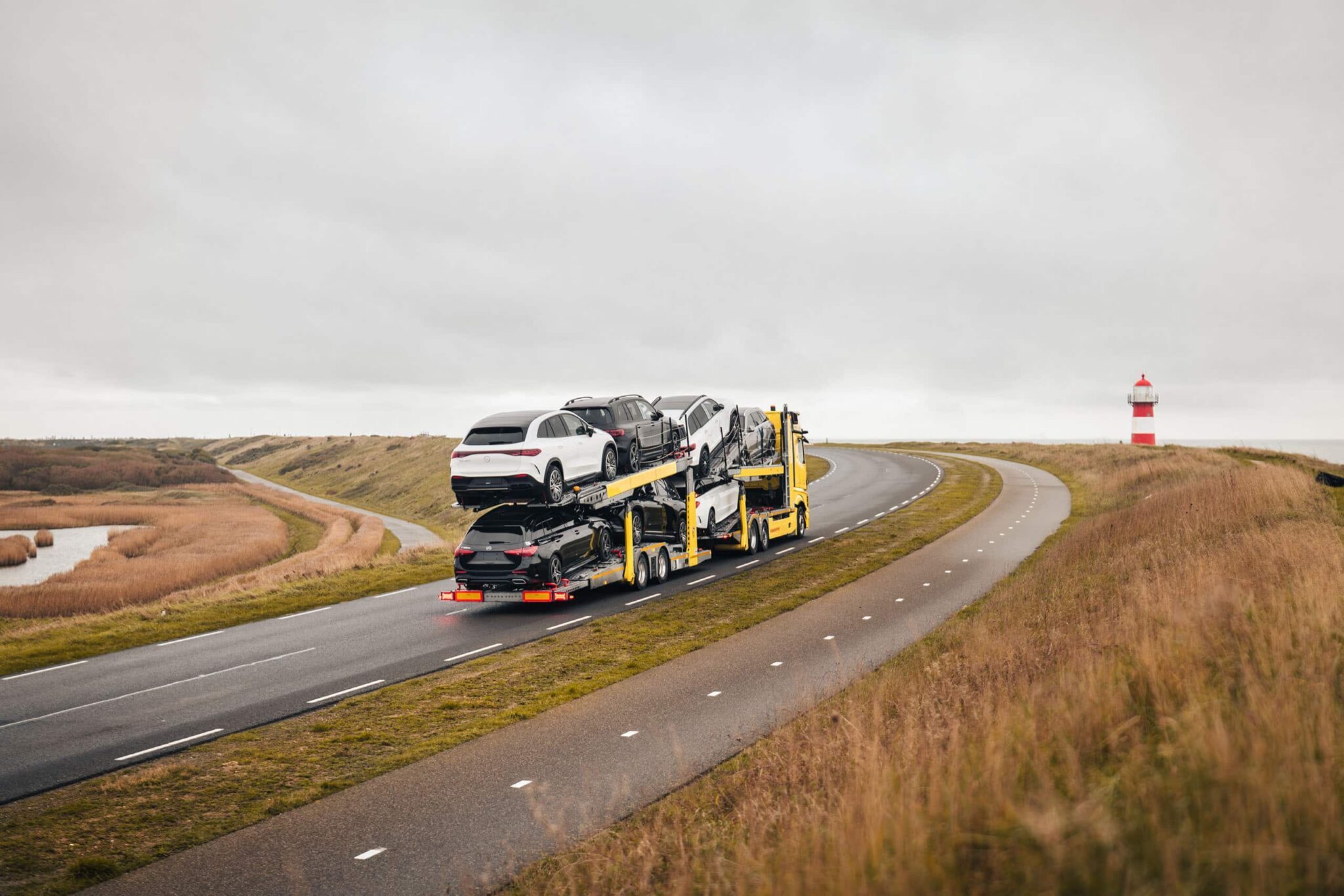
That puts logistics in a new light. A quick buying decision creates an expectation of quick delivery. A dealer who can deliver reliably and predictably keeps their reputation intact. A dealer where the car disappears "somewhere in the process" loses that advantage.
This is exactly why transport is no longer an afterthought. Anyone who wants to serve customers quickly and transparently needs a grip on when the car arrives. Book car transport with TransConnect and deliver as soon as the signature is in place.
What this means for you as a salesperson
Your buyer has changed. Not radically, but noticeably. They know more, compare more and are quicker to use their AI answer as a reference point. That calls for a different approach in your sales conversation. Three things that work:
Name the AI context. If a buyer mentions a price that differs from yours, ask where they got it. "Did you see that through ChatGPT or a pricing site?" That opens up the conversation instead of making it defensive.
Be concrete about what the price covers. Buyers who compare online often see bare list prices. Being more explicit about trade-in, warranty, delivery and service gives the comparison context. That narrows the gap.
Deliver fast. A buyer who decides quickly expects you to do the same. Delivery speed isn't just logistics. It's part of the customer experience after the signature.
AI is becoming a structural part of the buying process. Not dominant: you remain the decisive point of contact as a salesperson. But AI does change how your buyers enter the conversation. Better informed, with higher expectations, and sometimes with a certainty that isn't entirely correct.
That doesn't make you, if you operate transparently, quickly and honestly, any less relevant. On the contrary: it makes you indispensable.
Sources: VAD-Studie 2026 "Die Deutschen und der Automobilhandel", puls Marktforschung on behalf of the Verband der Automobilhändler Deutschlands (VAD), n=2,393, fieldwork 19 February–3 March 2026. Statements on AI in fleet management: panel debate at the Global Fleet Summit 2026, Brussels, 5 May 2026 (Nexus Communications), with Jesper Lyndberg (Alphabet) and Reggie Cabal (Orix).