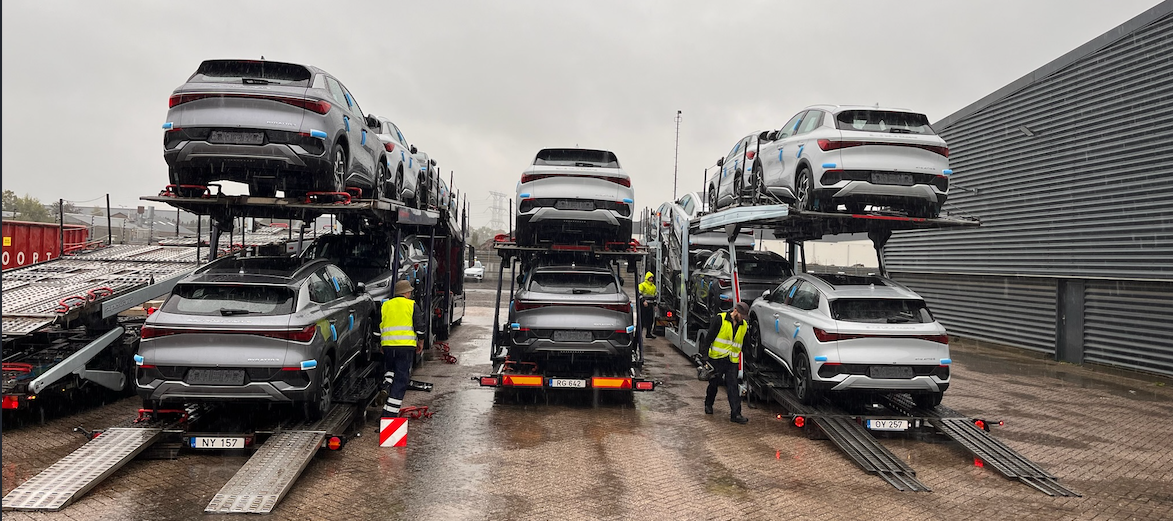
The driver arrives at the loading address. Loading cannot take place. The client provided the wrong pick-up code. The driver calls TransConnect. An attempt is made to obtain the correct code from the client. In the meantime, he waits. For half an hour, nothing happens. The driver eventually leaves, far later than planned. The schedule for his next loading and delivery locations is thrown completely off.
This is not an exceptional case. In our network alone, there are over 900 locations that require a pick-up code, around 450 where a booking through an external link is required before loading, and nearly 3,000 logistics centres that require a separate pick-up document. At every one of those locations, the rule is the same: if the right document is missing, the driver does not load. Transparency in car transport is not a soft concept. It is the difference between a transport that runs smoothly and one that causes delays, extra costs, and unnecessary rounds of communication.
In this article: which documents need to be in order for every transport, why digital follow-up speeds up the chain, and why this matters even more now that margins are under pressure.
What transparency in car transport actually means
Transparency is not about dashboards or reports. It comes down to one concrete question: does everyone in the chain have the right information at the right time?
The driver arriving to load a vehicle. The loading address that knows a transport is expected. The client who knows when their vehicle will be collected and what they need to have arranged. If one link is missing — a document, a pick-up code, a confirmation — the chain stops. Not briefly, but long enough to disrupt a schedule.
Transparency means visibility at document level, not just at status level.
The power of attorney: automatically generated, but not always enough
For every transport via TransConnect, a power of attorney is automatically generated. This gives the driver the document needed to collect the vehicle. Clients can set up their signature, stamp, or logo in the portal in advance, so every power of attorney is ready automatically — without manual input per order.
Each power of attorney at TransConnect also includes a unique QR code and a PIN code for manual verification. Before the vehicle is released, the loading address scans the QR code. The screen immediately shows whether the power of attorney is valid — including the driver's name, the vehicle registration, and the destination. If the order is cancelled or the carrier no longer has active authorisation, the QR code is automatically invalidated. Outdated or copied powers of attorney are therefore unusable. Read more about how this works: QR verification of the power of attorney.
But there is a detail that regularly causes delays in practice.
At a portion of European loading addresses — primarily in Germany and France — an additional power of attorney from the loading address itself is required, alongside the standard one. This is a requirement of the location, not of TransConnect. If that document is not present when the driver arrives, the collection cannot proceed.
In addition, for every transport: the details on the power of attorney must be correct. VIN number, loading date, driver's name, vehicle registration. If any detail differs from what the loading address expects, there is a dispute. And disputes cost time.
What a client must have arranged before the driver arrives:
- The vehicle has been paid for
- Pick-up codes and/or collection documents have been uploaded to the order in TransConnect
- The vehicle details in the order are correct: VIN, driveable or non-driveable, any extras
Anyone who arranges this in advance avoids an unnecessary round of communication.
The practical impact of delays varies. Sometimes a client sends the correct document within 30 minutes and the driver waits. Sometimes documents are not quickly available and the rest of the route falls behind. In the worst case, the transport is cancelled. The loading address will not hand over the vehicle without the required paperwork. The transport partner loses valuable time and the client waits even longer for their vehicle.
The most severe scenario occurs at locations with a mandatory time slot — addresses where a booking via an external link is required before loading. If that slot is missed because documents are missing, a new booking must be made. In some cases, the next available slot is not until a week later. The transport is delayed, and the schedule must be rebuilt from scratch.
CMR: the most underestimated link in the chain
The power of attorney authorises loading. The CMR waybill governs the handover — and with it, liability.
For every international road transport, the CMR is mandatory. But the document only has value if it is accurately completed, checked, stamped, and signed at the right moments: at collection and at delivery. Not one or the other — both.
Anyone who does not properly check the CMR at collection has no evidence of the vehicle's condition at the time of handover in the event of damage. Anyone who does not get a signature at delivery has no proof of a correct handover. In both cases, a dispute follows — and that typically costs more than the damage itself.
The CMR is not complicated. But it is too often treated as a formality rather than as an insurance policy. The difference lies in discipline at the moments that count.
More on the CMR waybill, its fields, and common mistakes: Paperless car transport and the eCMR.
Digital follow-up as an operational advantage
Transparency does not just resolve problems once they arise — it prevents them.
Take the loading notification. Before every collection, TransConnect sends a notification to the loading address on behalf of the transport partner: loading instructions, date, time window, the driver's name and registration, and the opening hours of both the loading and delivery address. The loading address does not need to be called. The driver does not need to ask whether he is expected.
In the client portal, the status of every transport is visible at any time:
- Prepayment — if applicable
- Planning in progress — including an estimated collection window
- Planned — confirmed date and time window, based on the opening hours of the loading and delivery address
- Loaded — collection confirmed
- Delivered — delivery confirmed
If anything changes in the planning, the client automatically receives a notification with the updated details — without needing to call or check.
The result: fewer phone contacts, faster turnaround, and lower operational costs.
Why this matters even more now that margins are shrinking
Margin pressure in car transport is increasing. Fuel costs, tolls, staffing costs, and regulation are making operations more expensive. The instinctive response is to look at rates. But the silent cost sits in the operation itself.
A half-day delay caused by a missing document costs more than the difference between two rates. An extra round of communication at collection costs planning capacity. A dispute over a poorly completed CMR costs time, attention, and sometimes money.
Those who want to reduce operational costs should start with the chain — not the rate.
Frequently asked questions
What happens if a driver arrives without the correct documents? The collection does not proceed. The loading address is under no obligation to cooperate without the required documents. The transport partner reschedules. This leads to delays and additional costs for everyone in the chain.
Who is responsible if a document is missing? It depends on where the breakdown occurs. If the client did not upload the pick-up code on time, the responsibility lies with the client. If a required document was not shared in time, responsibility lies with the party that should have arranged it. Transparency works both ways: the platform makes clear who needs to provide what, and when.
How do I know which documents are required for a specific address or country? Relevant documents and instructions are shared in the order as soon as the requirements of the loading address are known. For addresses that require an additional power of attorney — such as some locations in Germany and France — this is visible in the order before the collection takes place.
How TransConnect organises this
TransConnect generates the power of attorney automatically for every order. Clients set up their signature, stamp, and company details in the portal once. The power of attorney is then ready without manual input per transport. Pick-up codes and additional documents are shared in the order as soon as they are available. The loading address receives a loading notification before the driver arrives.
The result is a chain in which everyone knows what they need to know, at the right moment.